LET'S VISIT BANDA ACEH

Banda Aceh is the provincial capital of Aceh Province, formerly known as Kutaraja until 1962. On April 22nd, 2016, Banda Aceh celebrated its 814th anniversary. Today,...

DAYA TARIK WISATA JAWA TENGAH

Candi Borobudur merupakan candi Budha terbesar di dunia. Candi ini adalah salah satu masterpiece di antara tujuh keajaiban dunia. Candi Borobudur terletak di...

NGABEN: UPACARA ADAT PEMAKAMAN DI BALI

Upacara pemakaman jenazah atau kremasi umat Hindu di Bali atau dikenal dengan nama Ngaben merupakan suatu ritual yang dilaksanakan...

SEJARAH RUMPUN BAHASA AUSTRONESIA

Menurut Arkeolog Harry Truman Simanjuntak, Austronesia merupakan salah satu rumpun bahasa yang terbesar di dunia. Rumpun bahasa ini meliputi...

ALBERT EINSTEIN

Albert Einstein was born in Ulm, Germany, in 1879. As a young boy, Einstein lived in...

Tampilkan postingan dengan label Teaching. Tampilkan semua postingan

Selasa, 28 Maret 2017

PENGERTIAN, HAKIKAT, DAN MAKNA DEMOKRASI

Demokrasi berasal dari bahasa Yunani, demos yang berarti rakyat dan kratos yang berarti memerintah. Atau dengan kata lain demokrasi diartikan sebagai pemerintahan rakyat.

Menurut Abraham Lincoln, demokrasi diartikan sebagai pemerintahan dari rakyat, oleh rakyat, dan untuk rakyat. Pengertian ini dapat dijabarkan sebagai berikut:

Pertama, pemerintahan dari rakyat. Hal ini berarti kekuasaan yang dimiliki pemerintah pada dasarnya berasal dari rakyat.

Kedua, pemerintahan oleh rakyat. Dalam hal ini, rakyat mendelegasikan perwakilan mereka untuk melaksanakan sistem pemerintahan yang berlangsung.

Ketiga, pemerintahan untuk rakyat. Kekuasaan yang dipegang oleh pemerintah sudah tentu direncanakan dan dilaksanakan untuk kesejahteraan rakyat, bukan hanya untuk keuntungan penguasa semata.

Dari pengertian di atas dapat ditarik sebuah kesimpulan bahwa pada hakikatnya demokrasi adalah pembuatan keputusan secara bersama, yang ditentukan bersama-sama, dan tiap anggota memiliki hak yang sama untuk terlibat dalam pengambilan setiap keputusan.

Hal-hal lain mengenai pengertian, hakikat, dan makna demokrasi dapat dilihat di sini.

Sabtu, 24 September 2016

THE DRAGON KITE

Long ago in a village in China, a boy called Chang lived with his father. The village sat in a valley near a huge volcano that sometimes roared and spat and shook the ground.

Taken from www.123rf.com
Many of the boys in the village played rough and noisy games. But Chang sat quietly with his father, making kites to sell in the town.

They worked in a tiny room at the back of their house. Chang's father cut and sewed the kites with threads of silk and Chang painted them.

The people in the town loved their kites, but the ones they loved most were the dragons. Some dragon kites were huge and some were fierce. Some had big, bulging eyes and some had long bodies and scaly tails that twisted and twirled and sang in the wind.


From The Dragon Kite by Kenneth Steven

Kamis, 22 September 2016

WALT DISNEY'S GREATEST STORYMAN


Sometimes we think more about how animation is created than the people behind the scenes. Bill Peet has written and illustrated over thirty books for children, and he is one of the major storytellers behind well-known animated movies.

Bill Peet, taken from www.pinterest.com
Bill Peet began to develop his creative abilities at a young age. Peet grew up in Indianapolis, near the edge of the city, with access to the countryside. He also had the opportunity to visit his grandfather’s farm, which bordered wilderness. Those experiences, combined with trips to the zoo, provided the foundation for future drawings of animals. When Peet entered school, his constant drawing sometimes became a problem, although one teacher encouraged his drawing. He dared to dream of a career in which he could put his drawing habit to use. He won a scholarship to an art school after high school and studied there for three years.

After art school, Peet needed to figure out a way to earn a living. He heard that Walt Disney was looking for artists, so he moved to California. There, Peet sketched and planned screen stories. He eventually became a storyman. Animated movies are made up of many individual drawings. Peet did the complete storyboards for two movies, The Sword in the Stone and 101 Dalmatians. He also worked on Peter Pan, Dumbo, and The Jungle Book.

Peet’s children’s stories began as bedtime stories for his sons. He illustrated his stories with many animals and some people, too. Peet claims the reason for this is he loves to draw animals. Bill Peet used different media for his drawings. He drew in pastels, pencils, and ballpoint pen. He dabbled in oil painting for a brief time. Many of his book illustrations are done in colored pencils and ink. Two of Peet’s animated works won awards. He’s more well-known, though, as “Walt Disney’s Greatest Storyman.”

ALBERT EINSTEIN


Albert Einstein was born in Ulm, Germany, in 1879. As a young boy, Einstein lived in Munich and Milan. At the age of five, his father showed him a compass and explained how it worked. Albert was intrigued with the idea that something in “space” made the needle work. At this time, Albert’s mother also insisted that he learn to play the violin.
Taken from hfhy64.com

Albert was not considered very bright in school, and some even thought he had dyslexia and other learning problems. Many thought he was very slow. Nonetheless, school would go on to be very important to Albert, and he would go on to become a professor. 

He eventually went to school in Switzerland, where he graduated from the Federal Institute of Technology. He then worked in a patent office and on his doctorate degree. He later became a professor of physics. Einstein developed the theory of relativity and received a Nobel Prize in physics in 1921. He became famous throughout the world, which is very unusual for a scientist.


THE ANTELOPE

Taken from http://animalia-life.com/

An antelope is a hoofed animal with horns that are hollow. There are many different kinds of antelope. Antelope live in the mountains, deserts, and wetlands and are hunted by lions, hyenas, and other carnivores. They are light, quick-moving animals that can jump very well. Some antelopes can reach speeds as fast as 60 mph. They can bounce on all four legs. This is called pronking.

Antelopes feed on grass, desert plants, and young plant shoots. They also eat twigs and leaves. They swallow the food whole and then regurgitate it and chew it. This is called cud. Most antelopes live in Africa but have also been found in Asia and North America. Antelopes come in all different colors and sizes. The horns of antelope can be curved or straight. These horns never fall off and are used to get food.

An antelope has very keen senses. They have big eyes and keen hearing. This helps the antelope stay on constant alert for predators that may be nearby.


Jumat, 16 September 2016

Apa itu letak astronomis?

Letak astronomis adalah letak suatu tempat berdasarkan garis lintang dan garis bujurnya. Garis lintang adalah garis khayal yang melintang melingkari bumi. Garis bujur adalah garis khayal yang menghubungkan Kutub Utara dan Kutub Selatan. Secara astronomis, Indonesia terletak antara 95' BT - 141' BT dan 6' LU - 11' LS. Dengan letak astronomis tersebut, Indonesia termasuk ke dalam wilayah tropis. Wilayah tropis dibatasi oleh lintang 23,5' LU dan 23,5' LS. Perhatikanlah batas wilayah tropis dan letak astronomis Indonesia pada peta berikut ini. Benarkah Indonesia terletak di wilayah tropis?

Foto dari mastugino.blogspot.com
Kamu patut bersyukur pada Tuhan Yang Maha Esa karena tinggal di wilayah tropis seperti Indonesia. Sinar matahari selalu ada sepanjang tahun dan suhu udara tidak ekstrim (tidak jauh berbeda antarmusim) sehingga masih cukup nyaman untuk melakukan berbagai kegiatan di dalam dan di luar rumah. Lama siang dan malam juga hampir sama, yaitu 12 jam siang dan 12 jam malam. Bandingkan dengan negara-negara yang terletak di lintang tinggi. Pada musim panas, lama siang jauh lebih lama dibandingkan dengan malam. Sebaliknya, pada musim dingin, lama siang lebih pendek. Mengapa demikian? Diskusikan dengan guru dan teman kamu.

Keadaan suhu di daerah tropis berbeda dengan suhu di negara-negara yang terletak pada lintang sedang dengan empat musim, yaitu musim dingin, semi, panas, dan gugur. Pada musim dingin, udara sangat dingin sampai mencapai puluhan derajat di bawah nol celsius sehingga diperlukan penghangat ruangan. Jalanan tertutup salju sehingga kendaraan tidak bebas berlalu lalang. Pada saat itu, banyak penduduk melakukan kegiatannya di dalam ruangan, baik di rumah maupun di kantor. Sebagian dari mereka pergi berwisata ke daerah yang lebih hangat, yaitu di daerah tropis.

Pada saat musim panas, keadaan sebaliknya dapat terjadi. Pada saat itu, udara sangat panas, bahkan suhu udara dapat melampaui 40' celsius. Akibatnya, diperlukan pendingin ruangan agar tetap nyaman. Tentu saja kegiatan di luar ruangan sangat tidak nyaman karena suhu udara terlalu tinggi. Untuk menghindari udara panas, sebagian penduduk ada yang berenang di kolam renang atau di pantai.

Ali Baba and the Forty Thieves


Ali Baba was such a poor man that he had only had one shoe for his two feet. Even the mice in his house were hungry.

One day, his wife said, " We have no food in the house. No rice. No potatoes. Go and collect leaves in the forest so that I can make a soup."

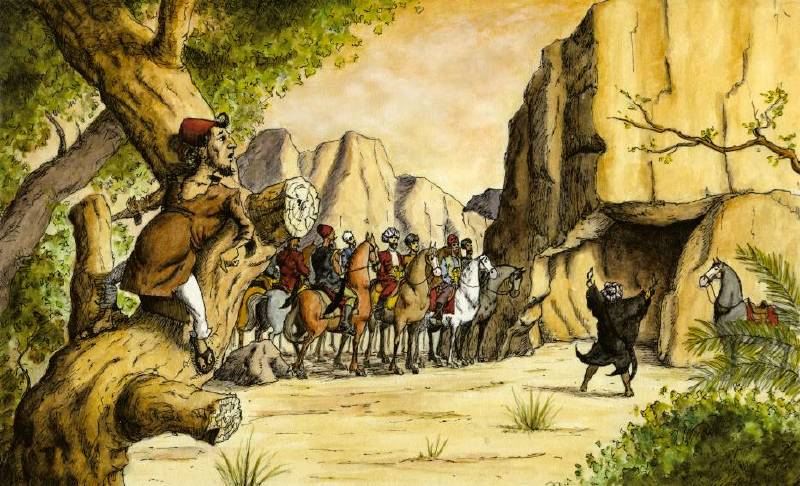
Ali was lazy man. He looked for leaves for about ten minutes and then he climbed a tree to sleep. He was afraid of wolves. When he woke up, he was surprised to see forty thieves on forty horses. They stopped in front of a big rock.

Taken from prezi.com
"Open Sesame!" shouted the leader. A door on the rock opened. The thieves carried sacks full of gold into the cave. When they had finished, the leader shouted.

"Close Sesame!" and the door closed. As soon as the thieves had disappeared Ali Baba jumped down from the tree, said, "Open Sesame" and went into the cave.

There were shelves all around the walls. The shelves were full of sacks. And the sacks were full of gold. Ali took a sack home with him.

Unfortunately, one of the thieves saw Ali's footprints on the sand. He followed them to Ali's home. He took out his knife and made a cross on the door.

"Now I shall know which house it is," he said. He rode off to get the other thieves. But Ali had seen the thief. He and his wife took brooms and swept away the footprints. Then he made crosses on every door at the street. When the forty thieves arrived they had their knives between their teeth. But they couldn't find either Ali – or the gold. And Ali and his wife lived happily ever after.


Kamis, 15 September 2016

ASEAN (Association of South East Asia Nations)

Adanya persamaan nasib sebagai negara yang pernah dijajah menimbulkan perasaan setia kawan yang kuat di kalangan bangsa-bangsa Asia Tenggara. Pengalaman tersebut kemudian mendorong bangsa-bangsa di Asia Tenggara untuk menghindari segala bentuk upaya pendominasian oleh negara lain. 

Adapun latar belakang berdirinya ASEAN adalah:
• Berakhirnya konfrontasi yang timbul di Asia Tenggara antara Indonesia, Malaysia, dan Filipina.
• Persamaan nasib akibat ditindas bangsa penjajah.
• Persamaan dalam bidang kebudayaan, bahasa, tata krama, dan pola kehidupan.
• Persamaan letak geografis yang strategis dalam percaturan politik dan ekonomi internasional.

Foto dari: www.asean.org
Berdasarkan persamaan dan latar belakang masing-masing negara, para pemimpin Asia Tenggara saat itu berusaha menciptakan perdamaian, kemajuan, dan kemakmuran di kawasan Asia Tenggara. Bangsa-bangsa di Asia Tenggara bersepakat untuk membentuk sebuah organisasi regional yang kemudian disebut dengan nama ASEAN (Association of South Asia Nations). Mereka merealisasikan kesepakatan tersebut dalam Deklarasi Bangkok yang ditandatangani pada tanggal 8 Agustus 1967 oleh Adam Malik (Indonesia), Tun Abdul Razak (Malaysia), Narcisco Ramos (Filipina), S. Rajaratman (Singapura), dan Thanat Koman (Thailand).

Sampai saat ini ASEAN memiliki sebelas negara anggota, yaitu:
1. Filipina (negara pendiri ASEAN)
2. Indonesia (negara pendiri ASEAN)
3. Malaysia (negara pendiri ASEAN)
4. Singapura (negara pendiri ASEAN)
5. Thailand (negara pendiri ASEAN)
6. Brunei Darussalam bergabung pada (7 Januari 1984)
7. Vietnam bergabung pada (28 Juli 1995)
8. Laos bergabung pada (23 Juli 1997) (Laos dan Myanmar bergabung pada waktu yang sama)
9. Myanmar bergabung pada (23 Juli 1997) (Laos dan Myanmar bergabung pada waktu yang sama)
10. Kamboja bergabung pada (16 Desember 1998)


Rabu, 14 September 2016

Perumusan Pancasila: Sidang Pertama BPUPKI

    Sidang Pertama BPUPKI
    Dalam sidang pertama, tanggal 29 Mei 1945, ketua Badan Penyelidik Usaha-usaha Persiapan Kemerdekaan Indonesia, dr. Radjiman Wedyodiningrat, mengajukan pertanyaan kepada anggota BPUPKI, "Negara Indonesia yang akan kita bentuk, apa dasarnya?"

    Sebagai tanggapan atas pertanyaan itu, para anggota BPUPKI mengemukakan pendapatnya mengenai dasar Indonesia Merdeka. Tiga orang mendapatkan kesempatan untuk mengemukakan pendapatnya, yaitu Muhammad Yamin, Soepomo, dan Soekarno.

    Muhammad Yamin mengusulkan dasar negara, sebagai berikut:
  1. Ketuhanan Yang Maha Esa
  2. Kebangsaan persatuan Indonesia
  3. Rasa kemanusiaan yang adil dan beradab
  4. Kerakyatan yang dipimpin oleh hikmat kebijaksanaan dalam permusywaratan perwakilan
  5. Keadilan sosial bagi seluruh rakyat

  6. Dalam pidato pada 31 Mei 1945, Soepomo mengemukakan pokok-pokok pikiran seperti berikut:
  7. Negara Indonesia Merdeka hendaknya merupakan negara nasional yang bersatu dalam arti totaliter atau integralistik.
  8. Setiap warganya dianjurkan agar takluk kepada Tuhan, tetapi urusan agama hendaknya terpisah dari urusan negara dan diserahkan kepada golongan-golongan agama yang bersangkutan.
  9. Dalam susunan pemerintahan negara, harus dibentuk suatu Badan Permusywaratan, agar pimpinan negara dapat bersatu jiwa dengan wakil-wakil rakyat secara terus-menerus.
  10. Sistem ekonomi Indonesia hendaknya diatur berdasarkan asas kekeluargaan, sistem tolong menolong, dan sistem kooperasi.
  11. Negara Indonesia yang berdasar atas semangat kebudayaan yang berdasar atas semangat kebudayaan Indonesia yang asli, dengan sendirinya akan bersifat Negara Asia Timur Raya.

  12. Pada 1 Juni 1945, Soekarno menyampaikan pidato tentang dasar negara. Pidato ini dikenal dengan sebutan "Pidato Lahirnya Pancasila". Dalam pidato ini, Soekarno menawarkan agar Indonesia Merdeka bukan negara agama dan bukan pula negara sekuler, tetapi negara yang berdasarkan Pancasila. Rumusan Pancasila ang diusulkan oleh Soekarno adalah:
  13. Kebangsaan
  14. Internasionalisme
  15. Mufakat dan Demokrasi
  16. Kesejahteraan Sosial
  17. Ketuhanan Yang Maha Esa

  18. Sumber: Saptono. 2007. Pendidikan Kewarganegaraan SMP Kelas VIII. Jakarta: PT. Phibeta Aneka Gama.

Senin, 25 Juli 2016

Mengenal Ideologi

    Ideologi merupakan gabungan dari dua kata, idea dan logos. Idea berarti gagasan, konsep, pengertian dasar, dan cita-cita, sedangkan logos berarti ilmu atau pengetahuan. Sehingga ideologi dapat diartikan sebagai ilmu pengetahuan tentang ide-ide atau ajaran tentang pengertian-pengertian dasar (Kodhi dan Soejadi, 1988:49).

    Ide dalam pengertian sehari-hari diartikan sebagai cita-cita. Cita-cita merupakan hal yang telah ditetapkan dan harus dicapai sehingga cita-cita bersifat tetap dan menjadi dasar, pandangan, ataupun paham. Cita-cita yang ingin dicapai merupakan dasar bagi usaha pencapaiannya, sedangkan dasar untuk bertindak berorientasi pada cita-cita yang ditujunya.

    Ideologi merupakan suatu doktrin, tata pendapat, atau pikiran dari seseorang atau sekelompok manusia berdasarkan pemikiran filsafat yang diyakini kebenarannya. Ideologi disusun secara sistematis serta diberi petunjuk pelaksanaannya dalam menanggapi dan menyelesaikan masalah yang muncul dalam kehidupan berbangsa dan bernegara.

    Beberapa orang mendefinisikan pengertian ideologi secara berbeda-beda, di antaranya:
  1. Lanur menyatakan bahwa ideologi bisa dimasukkan dalam kategori pengetahuan yang subyektif.
  2. C. C. Rodee menyatakan bahwa ideologi adalah sekumpulan gagasan yang secara logis berkaitan dan mengidentifikasikan nilai-nilai yang memberi keabsahan bagi institusi politik pelakunya.
  3. Carl J. Friederich mendifinisikan ideologi sebagai suatu sistem pemikiran yang dikaitkan dengan tindakan.
  4. Karl Marx mendefinisikan ideologi sebagai pandangan hidup yang dikembangkan berdasarkan kepentingan golongan atau kelas sosial tertentu dalam bidang politik atau sosial ekonomi.

  5. Berdasarkan beberapa pengertian di atas, maka sebuah ideologi akan menjadi sebuah falsafah hidup jik telah mendapatkan landasan atau pondasi berpikir sehingga menimbulkan motivasi yang jelas dan nyata. Oleh karena itu, ideologi juga diartikan sebagai seperangkat gagasan, ide yang membentuk landasan ekonomi dan politik dari seseorang atau sekelompok orang. Ideologi menjadi pegangan dalam kehidupan suatu bangsa. Hal itu dikarenakan ideologi dapat memberikan kejelasan identitas nasional, menimbulkan inspirasi untuk mendukung cita-cita dan tujuan yang ingin dicapai suatu negara.

Senin, 22 Februari 2016

Let's Talk about Human Rights

    In general, human rights are basic right that every human being as entitled as endowment from God. The following are the definitions of human rights.

  1. Prof. M. Koentjoro Poerbapranoto argues that human rights are the fundamental rights which are entitled to all human beings as their nature so that it is a pure matter.

  2. John Locke states that human rights are basic rights that are innate to all human beings.

  3. According to Law No. 26 Year 2000 on Human Rights Jurisdiction (Undang-Undang No. 26 Tahun 2000 tentang Pengadilan HAM), human rights are rights that are entitled as the nature and existence of God's creature and it is God's endowment that should be respected, protected by the state, law, government, and everyone for the sake of protecting human being's value.

  4. Kinds of Human Rights

    Basic rights that entitled to human beings are as many as their daily life activities. However, the human rights are commonly categorized into six areas of human life as follows.

  5. Personal rights are freedom to adhere everyone's respective religion, right to life, and right to freedom of speech.

  6. Property rights are ownership rights, right to sell and buy something, right to make contracts.

  7. Legal quality rights are rights to receive equal legal protection and government protection.

  8. Political rights are right to be recognized as an equal citizen. Thus, every citizen has rights to elect and to be elected, to found a political party or an organization, and to pose a petition, critic, and suggestion.

  9. Social and cultural rights are right to choose certain education or develop certain desirable culture.

  10. Procedural rights are rights to receive the same treatment on court procedures such as right to receive equal and proper treatment in arrest, detention, frisk, court, and legal advocacy.

Rabu, 17 Februari 2016

Controversy of Having Television

Almost 97 per cent Indonesian people have television. From this television, we get many benefits. However, if we observe by far, television also brings negative effects. Therefore, the existence of television programs lead controversy.

     The obvious benefit of having television is togetherness. For example, all members of a family are free at night. Usually, they gather in front of television and watch one of the programs. It means that television gives a family a chance to make an intimate communication. Besides that, television can be friend of someone who feels lonely being alone at home. It makes him/her not bored.

     Secondly, the benefit is about the programs broadcasted by many television stations. We can get many information such as newest news, tips about our lifestyles and some phenomena in our life. Moreover, there are many education programs that help students, for examples, English Time and Learning Physics.

     Thirdly, it is about amusement. There are musics, films, series, games, and comedy. For music lovers, they are amused by the music, clip video, and the biography of the celebrities. Well, the films broadcasted on television make film lover who do not have a chance to watch the film on the cinema, can enjoy the film at their home. For series lovers, they can get lessons of life because some Indonesian series presents conflicts that are usually happening in our daily life. Concerning to games, some television stations present games programs. They are usually educating, offering prizes or just amusing. The other amusing program is comedy. Usually we decide to watch television because we want to take a rest. Comedy program can rest our mind. It amuses us with light conflict presented by humor. Then, for parents who have difficulties to amuse their children, cartoon programs is suitable for them.

     On the other hand, some people have different point of view of having television. They think that there are many negative effects caused by television. Most children who still study have an habit, that is watching television. Some of them, watching television is more important than doing their homework. Some parents experience difficulties to stop their children not to watch television too much. Moreover, there are many children programs, for example cartoon series presented in the wrong time, especially in studying time.

     The other negative effect is caused by criminal news. Some viewers who are easy in despair may do the same thing. They cannot be selective to draw the message of the news presented. The next effect is wasteful. The lifestyles presented by TV programs through series, talkshow, and commercials can lead the viewers to change their lifestyles. We know that commercial breaks on TV can convince the viewers to buy their products.

     The other disadvantage is related to film and series. Many films and series show things which are not appropriate to show. Most of the films and series present themes about teenagers and love. Indirectly, they present the lifestyles of teenagers. For example, the theme is about love between students in junior high school or senior high school. The other example is that there are protagonist and antagonist in a film or a series. Some Indonesian series show antagonist who is very and very mean. Even, it is too mean than in our real life. this phenomenon can be imitated by children. It is no doubt if there are violences done by children.


     Based on those controversies, it can be concluded that having television brings advantages and disadvantages. Therefore we have to be selective in choosing the programs and drawing the message, moral, information presented by the programs. For parents, it is better for them to accompany their children when they watching television, so that they do not do, talk, and think something wrong. 

Both, Either, and Neither

    Both
  1. Both
  2. We use both when we are talking bout two things (usually a noun) or the two (the one and the other).
    Examples:
    • Hendry teaches Math. I teach Math. ---> Both Hendry and I teach Math.
    • Regal bookstore is expensive. Fill bookstore is expensive. ---> Both bookstores are expensive.
  3. Both of
  4. Both of refers to two persons or things. It always needs the/these/those/my/your/his, etc.
    Examples:
    • Which of the two pants do you want? ---> I want both of them.
    • Both of the bookstores are expensive. (not both of bookstores)
  5. Both . . . and . . .
  6. We can join simple statements together into compound sentences.
    Examples:
    • Mr. Andra teaches Science. He also teaches French. ---> Mr. Andra teaches both Science and French.
    • The students were tired. They were also thirsty. --- > The students were both tired and thirsty.

    Either
  7. Either
  8. We use either when we are talking about one or the other of two.
    Examples:
    • We can go to Jakarta market. We can go to Bekasi market. ---> We can go to either markets. I don't mind.
    • Park on either side of the road.
  9. Either of
  10. Either of means one of the two. It always needs the/these/those/my/your/his, etc.
    Examples:
    • Which of the two do you want? ---> Either of them will go.
    • We can go to either of those bookstores.
  11. Either . . . or . . .
  12. Example:
    • You must take it. I must take it. ---> Either you or I must take it.

    Neither
  13. Neither
  14. We use neither when we are talking about not one nor the other of two.
    Examples:
    • Regal bookstore is not expensive. Fill bookstore is not expensive. ---> Neither bookstores are expensive.
  15. Neither of
  16. Neither of means not one of the two. It always needs the/these/those/my/your/his, etc.
    Examples:
    • Which of the two shorts do you want? ---> I want neither of them. (I don't want those shorts.)
    • Neither of the bookstores we went to was expensive.
  17. Neither . . . nor . . .
  18. Examples:
    • Bryan cannot read. He cannot write. ---> He can neither read nor write.
    • He does not speak French. She does not speak English. ---> He speaks neither French nor English.
    • Sam didn't come to the party. Katty didn't come to the party. ---> Neither Sam nor Katty came to the party.

    Notes:
    Elliptical sentence (negative)
    John doesn't like milk and Chris doesn't like milk.
    ---> John doesn't like milk and Chris doesn't either.
    ---> John doesn't like milk and neither does Chris.

Clauses

      A clause is a group of related words that contains a subject and a predicate. A clause is divided into:

    1. Independent Clause
    2. A clause that expresses a complete thought and can stand alone as a sentence.
      Examples:
      Karina has always been a good student.
      Mahar is a handsome man.

    3. Dependent Cause
    4. A clause that depends on the rest of the sentence for its meaning. This type of clause can be classified as:
      1. Adjective clause
      An adjective clause is a dependent clause that modifies a noun or a pronoun. It is introduced by relative pronouns (who, whose, whom, which, or  that) or by subordinating conjunctions (where, when, why).
      Examples:
      The woman who speaks to them is their teacher.
      The book which you borrowed yesterday is new.
      The house of which the door is red will be renovated.
      1. Adverb clause
      An adverb clause is a dependent clause that modifies a verb, an adjective or an adverb. It is introduced by subordinating conjunctions, such as, when, where, before, since, as, so, because, though, although, unless, and etc.
      Examples:
      He spoke before he thought.
      It was hot hen we went out.
      1. Noun clause
      A noun clause is a dependent clause that is used as noun. It is introduced by words, such as who, which, that, where, when, how, and why.
      Examples:
      What he does is his business. (subject)
      Tell whomever you wish that story. (indirect object)
      I know where she lives. (object)
      Notes:
      Noun clauses are also called embedded clause.
      Embedded clause
      Embedded statement is used in place of noun phrase.
      Examples:
      I know the woman who is singing the song. --> I know the woman singing the song.
      The ma who standing beside me is my teacher.
      The wallet that was stolen yesterday has been found. --> The wallet stolen yesterday has been found.
      Some guests invited to the party cannot come.
      -ing is used to modify what somebody or something do. It has an active meaning. -ed is used to modify somebody or something with a passive meaning.

Natural Disaster

A natural disaster is a terrible accident, e.g. a great flood, a big fire or an earthquake. It usually causes great suffering and loss of a large sum of money. The casualties are injured or died. Some people are homeless and need medical care.

     Floods occur when the water of rivers, lakes, or streams overflow their banks and pour out onto the surrounding land. Floods are caused by many different things. Often heavy rainstorms that last for a brief time can cause a flood. But not all heavy storms are followed by flooding. If the surrounding land is flat and can absorb the water, no flooding will occur. If, however, the land is hard and rocky, heavy rain cannot be absorbed. Where the banks are low, a river may overflow and flood adjacent lowland.

     In many parts of the world flood are caused by tropical storms called hurricanes or typhoons. They bring destructive winds of high speed, torrents of rain, and flooding. When a flood occurs, the destruction to surrounding land can be severe. Whole villages and towns are sometimes swept away by water pouring swiftly over the land. Railroad tracks blocked and are uprooted from their beds. Highways are washed away.

     When a building caught fire, the fireman pitched in to help battle the blaze. Before the pumps were invented, people formed bucket brigades to fight fires. Standings side by side, they formed a human chain from the fire to nearby well or river. They passed buckets of water from to hand to be poured on the flames.


     The damage of the fire did depend a great deal on where it happened. In the country or a small village, only a single house might burn down. But in crowded cities, fire often destroy whole blocks and neighborhoods before being controlled.

Selasa, 16 Februari 2016

Piagetian View of Cognitive and Language Development

Piaget (1959) argued that cognitive development and language acquisition are closely interrelated processes. Toddlers develop an abstract knowledge about the world through experience with objects around them and by observing the way one object is acted upon by another. This stage of development is closely linked to the sensorimotor period, from birth to around 18 months. In Piaget's view, cognitive knowledge about the world is seen as a pecursor to language. Without cognitive development there can be little or no language acquisition. In other words, language is the manifestation of a child's developing cognition. Language is the means by which a child represents reality.

Figure 1. Cognitive and Language Development of Piaget's View
     This view is often referred to as cognitive determinism; the development of language forms is governed by cognitive growth, that is, cognitive development before language (see figure 1). In fact, in this view, the order of development within language learning is governed by the stages of cognitive growth. This concept has been challenged by many as being narrow or not completely accurate. Some research has shown that the relationship is not one way. For example, in some situations children have used language to express concepts such as object permanence and cause-effect at about the same time the concepts were being learned, rather than after as cognitive determinism would predict.

    In Piaget's view, language initially has an internal function. Children first use language privately for 'talking' about the environment and their experiences and only later for social interaction. Children may repeat something they hear for their own benefit, as a way of internalizing the input. For example, a child is told, 'You mustn't play with Mummy's lipstick'. The child later repeats that utterance to him/herself when alone, a phenomenon that is often observed before children fall asleep. Children also often talk to themselves when playing on their own. They 'talk' to themselves from the early stages of babbling, before they even have words. A child might play with toys in his/her room, babbling all the while 'hab dab dab dab dab. Dab dab dab. Hab dab' and sound exactly as if there is a conversation taking place even though there is no other interactant (other person in the interaction).


Source: Goh, Christine C. M. and Rita Elaine Silver.2004. Language Acquisition and Development: A Teacher's Guide. Singapore: Pearson Education South Asia.

Darimana Sel Eukariot Berasal?

Sampai degan sekitar tahun 1970, diyakini bahwa sel eukariotik berevolusi dari sel proariotik melalui suatu proses evolusi secara perlahan, yaitu organel pada sel prokariotik perlahan-lahan berkembang menjadi lebih kompleks. Konsep ini berubah setelah penemuan Lynn Margulis dari Universitas Boston. Margulis membuktikan teori yang sebelumnya diabaikan, yaitu organel-organel tertentu pada sel eukariotik, teutama mitokondria dan kloroplas berasal dari sel prokariotik yang berukuran kecil. Sel proakriotik tersebut menempati sitoplasma sel inang yang berukuran besar sehingga terbentuk sel eukariotik.

     Hipotesis tersebut dikenal sebagai teori endosimbiotik. Teori endosimbiotik bermakna bahwa sel tunggal yang kompleks berevolusi dari dua atau lebih sel yang lebih sederhana, yang hidup simbiotik dengan sel inangnya.

     Nenek moyang sel eukariotik yang pertama diduga merupakan bakteri heterotrofik anaerob. Disebut sebagai bakteri anaerob karena energi bakteri ini berasal dari perombakan makanan tanpa menggunakan oksigen. Disebut sebagai bakteri heterotrof karena bakteri energi bakteri ini tidak dapat menyintesis makanannya (seperti CO2 dan air), memerlukan senyawa kompleks dari lingkungannya.

     Sesuai dengan teori endosimbiotik, ada organisme prokariot yang relatif besar, bersifat anaerob dan heterotrof, yang menelan organisme prokariot yang berukuran lebih kecil dan bersifat aerob. Prokariot yang berukuran kecil itu diduga merupakan bakteri fotosintetik ungu. Namun karena tidak dapat dicerna oleh sitoplasma prokariotik yang lebih besar, sel prokariot yang lebih kecil tersebut tinggal menetap dan membentuk endosimbion di dalam tubuh sel inangnya. Saat sel inang bereproduksi, endosimbion juga bereproduksi. Setelah beberapa generasi, endosimbion kehilangan sifat-sifat yang tidak dibutuhkannya lagi dan berevolusi menjadi organel mitokondria yang kita kenal sekarang ini.

     Diduga juga bahwa bergabungnya endosimbion lain, terutama Cyanobacteria, menyebabkan organisme eukariot heterotrof yang ada pada masa awal berubah menjadi organisme heterotrof fotosintetik sekarang, yaitu alga dan tumbuhan hijau. Penggabungan kloroplas merupakan tahap terakhir dalam proses ndosimbiotik karena semua mikroorganisme eukariot mempunyai mitokondria, namun hanya alga dan tanaman yang mempunyai kloroplas.


Sumber: Kurniawan, Arif, dkk. 2008. Biology Insight: Mengkaji Kehidupan, Memupuk Keimanan. Sukoharjo: Hamudha Prima Media.

Kamis, 11 Februari 2016

What is 'three level guides'?

    A three level guide is a way of approaching a piece of text. It aims to improve the reader's comprehension. The three levels to guide the reading are:
    1. Level 1: Literal comprehension
    Reading the words on the lines.
    What is the author actually saying?
    1. Level 2: Interpretive comprehension
    Reading between the lines.
    What does the author actually mean?
    1. Level 3: Applied comprehension
    Reading beyond the lines.
    How does what the author says relate to what I already know, how can I use it and does it affect my beliefs?

    What is the value of a three level guides?
    As a way of improving reading for meaning, H.L. Herber developed three level guides in his book Teaching Reading in Content Areas (Prentice-Hall, Englewood Cliffs, New Jersey, 1978). Herber believed that to comprehend, readers must first be able to find what the author actually says. This is working out the literal meaning of the text. Next, the reader must think about what the author means, that is, interpreting the text. Finally, the reader needs to be able to use the meaning of the text, that is, applying the information. By doing these three things, readers gain a better understanding of a text.

    Source: Anderson, Mark and Kathy Anderson. 1997. Text Types in English 2. South Yarra: Macmillan Education Australia Pty Ltd.

Let's talk about SQ3R

    What is SQ3R?
    F.P. Robinson, in his book Effective Study (Harper and Row, New York. 1967), developed the SQ3R approach for improving literacy. SQ3R stands for survey, question, read, recite and review.

    What is the value of SQ3R?
    SQ3R is a very useful procedure when you have to read and understand a difficult or unfamiliar piece of text.

    Procedure for using SQ3R
    There are five steps for using SQ3R.
  1. Survey the text. This means skimming through it and noticing the headings, any words in bold, pictures, diagrams and the general layout of the text. By surveying you will gain an understanding of the context of the text and will not be going into it 'blind'.
  2. Question. Make up a list of questions that will help direct your reading. This will help you read for meaning. Some questions you might use are:
    • What do I think the text will be about?
    • What am I expected to know when I finish reading the text?
    • What is the purpose of the pictures and diagrams?
    • Why has the text been laid out the way it has?
    • How will I recognise the main points?
  3. Read the text and look for answers to the questions you developed in step 2.
  4. Recite, that is, say aloud what you understand about the text and you answers to your questions. Put into your own words what you have read.
  5. Review the text, that is, read over it again. Check you have not misunderstood any details. Check that your answers to your questions do fit the text.

  6. Source: Anderson, Mark and Kathy Anderson. 1997. Text Types in English 2. South Yarra: Macmillan Education Australia Pty Ltd.